
Company Overview
Business Background
Business Challenges
- Multiple disconnected tools across departments
- Manual, paper-heavy HR processes
- No centralized CRM for tracking leads and deals
- Project management scattered across spreadsheets and chat threads
- Poor document collaboration and version control
- Communication gaps between teams
- Limited visibility into customer support activity
Business Requirements
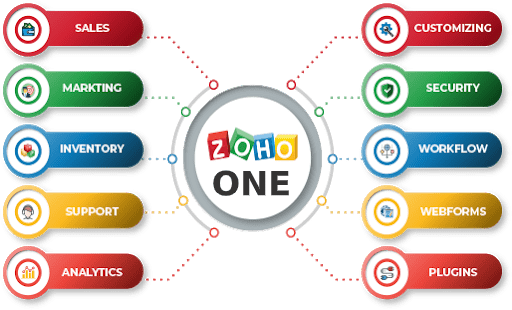
Kodivian wanted a centralized ERP-style ecosystem built on Zoho One, bringing CRM, HR, projects, document management, communication, and support onto one connected platform.
Modules Implemented
| Zoho CRM | Lead management, contact management, deal pipeline, sales process design, workflow automation |
| Zoho People | Employee records, leave management, attendance, core HR processes |
| Zoho Desk | Customer ticket management and support automation |
| Zoho Projects | Project planning, task management, time tracking |
| Zoho WorkDrive | Centralized document management, file sharing, version control |
| Zoho Cliq | Internal communication, department channels, notifications |
| Zoho Meeting | Online meetings and team collaboration |
| Zoho Mail | Business email setup and group mailboxes |
| Zoho SalesIQ | Website visitor tracking, live chat, lead capture |
Implementation Methodology
- Discovery meetings with department heads
- Requirement gathering across CRM, HR, projects, and support
- Business process mapping
- Solution design across the Zoho One suite
- Zoho configuration for each module
- User and role configuration
- Workflow automation across departments
- System testing
- User Acceptance Testing (UAT)
- User training by department
- Go-live
- Post-go-live support
Integration Strategy
Because every application sits under Zoho One, users, permissions, and core data are shared across modules rather than duplicated. A lead converted in Zoho CRM can flow into a project in Zoho Projects, support conversations in Zoho Desk are visible against the same customer record, and Zoho Cliq notifications keep every department informed of activity elsewhere in the system — so the platform behaves as one connected system rather than nine separate tools.
Challenges During Implementation
Rolling out nine modules at once meant training had to be carefully sequenced so no single department was overwhelmed — training was run module-by-module, aligned to each team’s own workflow, rather than as one company-wide session. Migrating historical HR and CRM records also required a data-cleansing pass before go-live to avoid carrying old inconsistencies into the new system.
Our Implementation Framework
Every engagement we deliver — regardless of size or which Zoho applications are involved — follows the same underlying methodology. This consistency is what keeps projects predictable for clients and lets us bring lessons from one implementation into the next.
1 Discovery | 2 Requirements | 3 Analysis | 4 Solution Design | 5 Configuration | 6 Automation | 7 Testing | 8 Training | 9 Go-Live | 10 Support |
Discovery and requirement gathering set the foundation — understanding not just what a client asks for, but why, so the resulting configuration actually matches how people work. Business analysis and solution design translate those requirements into a concrete Zoho architecture. Configuration and customization build it; workflow automation removes manual steps; testing and UAT confirm it holds up under real use. Training and go-live bring users onto the new system, and support plus continuous improvement keep it working well after launch.
Our Implementation Approach
Every project we take on includes the same core practices, adapted to the client’s scale and industry:
- Requirement workshops with the teams who will actually use the system
- Gap analysis between current process and desired outcome
- Business process mapping before any configuration begins
- Best-practice recommendations drawn from prior implementations
- Careful configuration and, where needed, customization
- Structured testing and User Acceptance Testing
- Hands-on user training, by team and by role
- Clear documentation and knowledge transfer
- Hypercare support in the weeks following go-live

Closing Note
No two businesses run the same way, and no two Zoho implementations should look identical either. Our approach starts with understanding how a business actually operates before a single module is configured — because a solution that fits the way people already work gets adopted; one that doesn’t, gets worked around.
The goal in every engagement is the same: a scalable, user-friendly, business-focused implementation that improves day-to-day productivity and holds up as the organization keeps growing.